
Seasonal restart & intermittent faults
Boiler Repair in North Medford
Get ready for boiler service in North Medford with guidance on seasonal restart, intermittent shutdowns, changing room use, and maintenance decisions.
- System-specific guidance
- Clear repair questions
- You approve the work

Your property, understood
A practical guide for your address
A heating problem that appears when the weather changes deserves a different conversation from an appliance that stopped suddenly yesterday. This North Medford guide focuses on seasonal restart, changing use of rooms, and the difference between an idle system, a control problem, and a developing mechanical fault. It is intended for residents preparing a precise service request, not as a claim that one housing style or boiler type defines the neighborhood.
01 / LOCAL GUIDE
Establish what is known about the property
The City of Medford recognizes North Medford among its neighborhood communication areas. That identifies a local context for this guide, but it does not provide a verified inventory of heating equipment or fuel types. Accordingly, the recommendations below are conditional: they apply when the described system or room arrangement exists at your address. They are not claims about measured neighborhood failure rates.
Start with how the home is used now. A rarely occupied guest room may have become a daily workspace; a side addition may follow a different schedule; or a previously satisfactory setting may no longer suit the occupants. These changes do not rule out a fault. They help the independent provider distinguish a new performance requirement from a component that has stopped doing its previous job.
02 / LOCAL GUIDE
Separate three seasonal complaints
The first heating demand produces no response
After a period without space-heating demand, a thermostat schedule or control setting may differ from what the occupant expects. The boiler may also have developed a fault. State whether the display is on, whether a code appears, and whether domestic hot water still works if supplied by the same appliance. Do not assume that summer hot-water operation proves the space-heating controls and circuits are functioning.
Heating runs but recovery is unusually slow
Compare the current pattern with previous ordinary use rather than with a guessed warm-up time. A deep setback, a newly occupied room, a distribution problem, or another condition may matter. Tell the provider which areas recover and which remain cold. A general instruction to turn the boiler temperature higher may miss the cause and should not replace an assessment of the installed system.
A shutdown appears only during longer runs
Some faults become apparent after sustained demand rather than at initial startup. The provider may need to understand the duration of operation, the final code, and which functions stop. Record the sequence safely from outside the appliance. A boiler that works for a short visit may still have an intermittent complaint that requires a different observation window or additional evidence.
03 / LOCAL GUIDE
Build a seasonal restart record
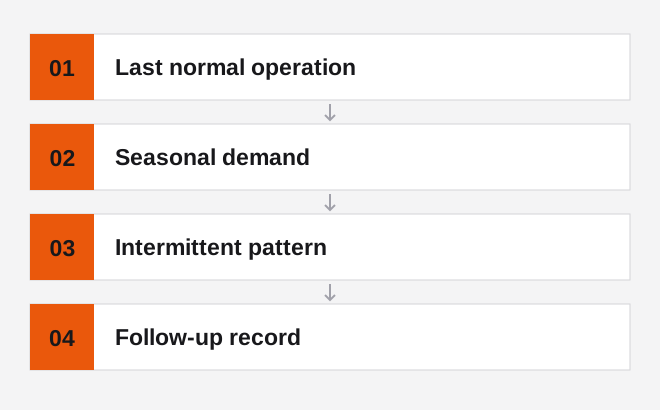
Note the last known normal operation
Identify when space heating last worked as expected and whether the appliance served hot water during the intervening period. Mention any service, control replacement, electrical interruption, or work near the system. The goal is a factual timeline. Avoid treating an event as the cause merely because it occurred before the symptom; the provider still needs to verify the connection.
Review owner controls without experimenting
Consult the normal operating instructions for the thermostat and boiler. Record the intended schedule and mode, and explain any setting you changed. Do not open wiring compartments, bypass safety inputs, or repeatedly reset a fault. If the control interface is unfamiliar, a photograph taken safely can help the provider understand what the occupant sees without inviting internal troubleshooting.
Distinguish appliance operation from room response
Observe which rooms receive heat during normal operation and whether one thermostat serves the whole area. A running appliance and a cold room can coexist for several reasons. The provider needs to determine whether useful heat is produced, distributed, and delivered. Your room list helps organize that assessment without requiring you to identify pumps, valves, or hidden piping.
Preserve the findings after the visit
Ask for the diagnosed cause, changed settings, completed work, and any follow-up recommendation. If the problem could not be reproduced, the record should state that limitation. Keep notes of any recurrence with dates and conditions. This is more useful than repeating the earlier assumption that a particular sensor or control must be responsible.
04 / LOCAL GUIDE
Rooms over or beside unheated space
If a room sits above an unheated garage, beside a less conditioned area, or within a later addition, tell the provider about that relationship. It may be relevant to the room’s heating demand and distribution, but it does not establish the diagnosis. Some complaints require both a heating-system assessment and a separate review of the building envelope.
The key distinction is whether the room’s emitter remains cold, warms incompletely, or becomes warm without achieving comfort. Those patterns suggest different questions. A provider should explain whether the proposed intervention restores an existing function, changes the distribution, or addresses a broader room-performance issue. This conditional scenario is not a claim that North Medford homes universally have garages or additions.
Ready to discuss your heating problem?
Share the symptoms and confirm the next step with an independent provider.
05 / LOCAL GUIDE
Choose a focused service pathway
Repeated ignition faults
An externally displayed ignition message describes a detected condition, not necessarily a failed igniter. Record whether the boiler never lights or lights briefly before stopping. The pilot and ignition guide explains the sequence-based approach and why repeatedly clearing a lockout does not establish a repair.
Pressure changes or visible moisture
State when the gauge changes and whether water is visible. Avoid adding water repeatedly without understanding the installation and the cause of loss. The leak and pressure guide separates expansion, filling, discharge, and external leakage as different questions for a professional assessment.
Cold emitters with an operating boiler
Identify the affected rooms and whether they respond to the same control. The radiator and baseboard service concerns distribution and emitter behavior as well as the appliance. A cold room is not, by itself, proof that the burner or entire boiler needs replacement.
06 / LOCAL GUIDE
Maintenance planning after the immediate fault
Once an active defect is addressed, ask what routine maintenance the actual model requires and what records are missing. A planned service can establish a useful baseline, but it should not be represented as a guarantee against every future failure. Separate appliance maintenance from any proposed water-side cleaning. They answer different needs and should have distinct descriptions in the scope.
If a provider recommends power flushing, ask what evidence indicates contamination, whether the system is suitable, and what alternative causes were considered. The maintenance and cleaning guide explains why an annual boiler visit does not automatically imply an annual whole-system flush. Do not add treatment products yourself based on a generalized seasonal checklist.
07 / LOCAL GUIDE
Prepare the property for a useful appointment
Arrange a safe route to the equipment and make the relevant controls accessible. Tell the provider about pets, locked rooms, or an occupant who needs coordination before entry. If an affected area is normally unused, do not leave it inaccessible simply because the boiler is elsewhere. The room response may be necessary to assess the original complaint.
State who can approve the diagnostic fee and additional work. Discuss parts availability and any interruption required before committing to a repair. Keep the distinction between a requested appointment and confirmed attendance clear: this website cannot promise that a suitable provider is available at a particular time for every North Medford address.
08 / LOCAL GUIDE
Do not let a seasonal explanation hide danger
A gas odor, carbon monoxide alarm, smoke, or suspected fuel escape is not a normal sign of “starting up for winter.” Leave the affected area and contact emergency responders or the utility from a safe place. Do not continue running the equipment to see whether the condition disappears. For ordinary faults, avoid hot discharge and wet electrical areas, and follow only model-specific owner instructions.
09 / LOCAL GUIDE
North Medford planning questions
Does summer hot water prove the boiler is ready for heating?
No. Where one appliance supplies both functions, space heating may involve different demand signals, valves, or circulation paths. Tell the provider which function still works. That distinction can help narrow the investigation without making assumptions about the failed component.
Is slow warm-up always a boiler fault?
Not always. Controls, distribution, emitter performance, room conditions, and the starting temperature may all affect recovery. A provider should assess the specific pattern and explain the evidence for the proposed work rather than infer a cause from elapsed time alone.
Should I schedule cleaning before diagnosis?
If you are reporting a current fault, make that clear first. Routine servicing or circuit cleaning may not resolve an unrelated control or component problem. Ask the provider to distinguish investigation from planned maintenance in the appointment and quotation.
How do I confirm coverage for my home?
Provide the full address, fuel and model if known, and the seasonal or intermittent pattern through Request Service. You can also compare the Medford service categories. Boiler Repair Pro connects inquiries with independent providers, who decide suitability, availability, pricing, and any repair warranty.
Sources & further reading
Neighborhood sources establish building context, not current heating installations or provider coverage.
Take the next step.
Tell us where help is needed and what your system is doing.