
Multi-level homes & vertical distribution
Boiler Repair in Medford Hillside
Explore boiler repair in Medford Hillside through floor-by-floor comfort patterns, converted rooms, and careful distribution assessment.
- System-specific guidance
- Clear repair questions
- You approve the work

Your property, understood
A practical guide for your address
Heating problems in a multi-level home are easiest to discuss floor by floor. An upper bedroom that stays cold, a comfortable middle floor, and a hot basement can reflect different control and distribution conditions. This Hillside guide concentrates on that vertical pattern and on homes whose layouts have changed over time. It does not assume that every Hillside property is on a slope, has the same boiler, or experiences the same defect.
01 / LOCAL GUIDE
Local context without mechanical assumptions
The Historical Commission’s Cotting Street inventory documents a mixture of building forms and periods in the Hillside area, including single-family and multifamily examples. It also describes adaptations over time. That supports checking the present layout rather than inferring it from the façade. The inventory does not establish which properties now have steam, hot-water radiators, baseboard, or other heating equipment.
For a service request, explain the number of occupied levels, where the thermostat is located, and whether any floor was converted or extended. A provider needs the actual connected system, not a neighborhood stereotype. If a room has a separate heater or an inactive old radiator, mention that distinction so it is not mistakenly included in the boiler’s current serving area.
02 / LOCAL GUIDE
Read the vertical comfort pattern
The highest occupied floor is slow to warm
In a hot-water system, a professional may need to assess circulation, air management, and the installation’s operating conditions. That does not mean the correct response is simply to raise the fill pressure. The system height and equipment requirements must be considered together. Steam heating requires a different interpretation, including its intended venting and return arrangement, rather than a hydronic refill procedure.
Lower rooms warm before the thermostat is satisfied
The control’s location and the circuit arrangement can influence how different spaces respond. If the thermostat is in a room that warms unusually quickly or slowly, report that observation. A provider may need to distinguish a distribution issue from a control-location problem. Moving a thermostat or increasing a setting should be a considered recommendation, not a substitute for understanding the pattern.
One level behaves independently
A converted upper floor or finished lower level may have a separate zone, different emitters, or another heat source. Identify the control used in that area and whether it changes boiler operation. A professional should verify the circuit rather than assume all radiators above one another are connected. Changes made during earlier alterations may not follow the layout that seems obvious from room positions.
03 / LOCAL GUIDE
Street slope is not a boiler diagnosis
A house’s position on a hill does not by itself prove a heating-pressure problem. The relevant installation details include the vertical relationship between equipment and emitters, the system design, and the components controlling operation. Outdoor elevation and the building’s internal heating arrangement are different facts. Avoid accepting an explanation that attributes every cold upstairs room to the neighborhood’s name or terrain.
A provider should be able to describe which measurement or observation supports the diagnosis. If pressure is involved, ask which circuit is being measured and what requirements apply to it. If circulation is involved, ask which zone or emitter pattern was assessed. This keeps a plausible-sounding location explanation from replacing evidence at the equipment.
04 / LOCAL GUIDE
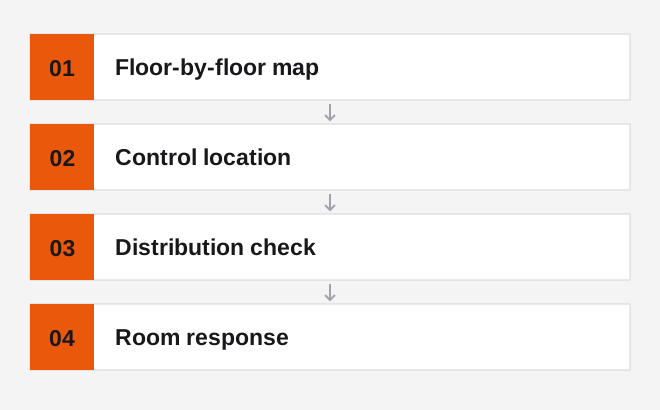
Prepare a floor-by-floor service brief
Sketch the served rooms
Make a simple list of rooms by level and note the visible emitter type. You do not need a technical drawing. Indicate which spaces are cold, comfortable, or unusually warm under normal use. Add the thermostat location and any separate controls. This gives the provider a starting map while leaving actual pipe and circuit identification to the professional.
Identify recent use or layout changes
State whether an attic, basement, porch enclosure, or other area became occupied after the heating system was installed. Mention any removed radiator or newly enclosed baseboard. An alteration can change how heat is distributed or how the building is used, but it is not proof of the fault. The provider can assess its relevance alongside the operating evidence.
Compare a recovery period with steady operation
If it is safe and practical to observe ordinary operation, distinguish rooms that eventually recover from rooms that never do. Note whether the complaint follows a large scheduled temperature setback. Do not repeatedly change settings to create a test. The aim is to report the normal behavior so a professional can decide which controlled checks are appropriate.
Arrange access beyond the boiler
The provider may need to see emitters or controls on several levels. Explain stair access, locked areas, and any occupied rooms that need advance coordination. An inspection limited to the basement may not establish why an upper room remains cold. Ask how unavailable access affects the diagnosis and whether the initial visit can still answer the main question.
Ready to discuss your heating problem?
Share the symptoms and confirm the next step with an independent provider.
05 / LOCAL GUIDE
A diagnostic example for a converted upper room
Suppose an upper room used as a home office remains cold, while the original bedrooms below it are comfortable. If its emitter never warms, the provider may investigate the serving circuit and control response. If the emitter warms but room temperature remains low, the room’s heat delivery and building conditions may need a broader assessment. Those are separate paths, even though the occupant describes both as poor heating.
This is an illustrative scenario, not a documented Hillside project. A room’s location does not establish whether its emitter is sufficient or whether a larger boiler is justified. Ask for the reasoning that connects the proposed work to the observed room performance. A more powerful appliance cannot be assumed to correct every distribution or room-specific limitation.
06 / LOCAL GUIDE
Symptoms that change the service category
A visible leak accompanies the cold floor
Report both the water and the comfort pattern. The location where moisture appears may not be the origin, and the provider should identify the affected fluid circuit. Refer to leak and pressure repair for the distinction between recurring water loss and other gauge behavior. Do not keep replenishing water to conceal a repeated drop.
The appliance supplies inconsistent tap water
A domestic hot-water complaint may follow a different pathway from cold radiators. Tell the provider whether all fixtures are affected and whether simultaneous use changes the symptom. The gas and combi guide explains why hot-water demand and space-heating demand should be tested separately where the appliance serves both.
The boiler stops before any floor warms
A shared shutdown needs an appliance-level investigation before a detailed room balance assessment. Preserve the externally displayed code and describe the startup sequence. If the fault concerns ignition, see pilot and ignition repair. Do not force repeated restarts to obtain one successful cycle.
07 / LOCAL GUIDE
Ask for a scope that matches the level of uncertainty
An initial diagnosis may identify a failed valve or pump, or it may establish that further distribution assessment is needed. Those outcomes should be described honestly. Ask what has been confirmed, what remains a hypothesis, and what additional access or records would help. A quotation should separate repairs from optional control changes or room-comfort improvements.
If work affects a shared or converted property, clarify who approves changes and which occupants will lose heat during isolation. Retain the circuit notes afterward. Accurate information about which rooms a zone serves is useful beyond the current repair and reduces the chance that future adjustments target the wrong part of the house.
08 / LOCAL GUIDE
Observe from a safe position
Do not open hot radiator fittings, remove boiler covers, or operate unfamiliar fill valves to investigate a cold upper floor. Leave old or unidentified insulation undisturbed. If a carbon monoxide alarm activates or you suspect a gas escape, leave and contact emergency services or the utility from outside. Photographs and service forms can wait until the situation is safe.
09 / LOCAL GUIDE
Hillside heating questions
Does a sloping street require a special boiler pressure?
Street slope alone does not determine the correct operating condition. The professional must assess the actual system configuration, internal height relationships, and equipment requirements. No universal pressure number is appropriate for every Hillside installation.
Can a thermostat change fix an upstairs complaint?
It may be relevant if the controls are part of the problem, but the serving circuit and emitter response need assessment. A thermostat cannot compensate for every restriction, inactive zone, or insufficient room heat delivery. Ask why the proposed control change addresses the observed pattern.
Must the provider visit every floor?
That depends on the complaint and the installation. For a vertical imbalance, access to affected emitters and controls can be important. Explain restrictions before booking so the provider can discuss whether the visit can establish a useful diagnosis.
What is the next step for my Hillside address?
Send the floor-by-floor observations through Request Service, including your address and equipment type if known. The Medford service overview lists the available categories. Provider coverage and scheduling are confirmed individually; Boiler Repair Pro is a referral website and does not claim a Hillside office or completed local jobs.
Sources & further reading
Neighborhood sources establish building context, not current heating installations or provider coverage.
Take the next step.
Tell us where help is needed and what your system is doing.