
Medford, Massachusetts / Boiler Maintenance & Power Flushing
Boiler Maintenance & Power Flushing in Medford
Separate boiler servicing from hydronic circuit cleaning. Learn when power flushing may be suitable and request maintenance help in Medford.
- System-specific guidance
- Clear repair questions
- You approve the work
Know what to ask
Start with the right diagnosis
Routine boiler servicing and cleaning the heating-water circuit are related but different tasks. A combustion appliance may need inspection and servicing even when its distribution water is clean. A poorly circulating heating circuit may require investigation even when the burner works normally. Power flushing is one possible cleaning method for suitable systems, not a universal treatment for every cold radiator, noisy boiler, or high heating bill.
01 / SERVICE GUIDE
Separate three kinds of work
Appliance maintenance
This concerns the boiler and the checks specified for its model, fuel, and installation. Appropriate professional work may include inspection, cleaning where required, and verification of operating and safety functions. The exact scope belongs to the manufacturer’s instructions and the equipment condition. Ask what the service includes instead of assuming that a brief visual visit is equivalent to the full maintenance schedule.
Heating-circuit cleaning
The hydronic circuit can contain installation debris or corrosion products that interfere with performance. The provider should determine whether contamination is actually relevant and which cleaning method suits the materials, components, and condition. A system may require a targeted intervention rather than an extensive whole-circuit treatment. Cleaning should address an identified need, not be sold solely because the boiler has reached a particular age.
Domestic-water treatment
In a combination boiler, the domestic-water side is distinct from the water circulating through radiators. A restriction affecting tap-water performance is not automatically resolved by cleaning the heating loop. The provider must identify the affected pathway and use a procedure approved for that equipment. Terms such as “flush” and “descale” should be explained precisely in the quotation.
02 / SERVICE GUIDE
Symptoms that justify assessment
Uneven or slow heat distribution
Cold areas and long warm-up times may involve contamination, but they can also result from valve, pump, control, or balancing issues. Ask how the provider distinguished those possibilities. If one zone fails entirely while others work, the common component serving that zone may be more relevant than a whole-system flush. A symptom list alone does not establish the appropriate cleaning scope.
Recurring noise or poor circulation
Noise can reflect several conditions and should be interpreted alongside the system type and observed operation. A provider may need to assess air management, flow, or mechanical condition before recommending cleaning. Avoid accepting a promise that flushing will cure every sound. Ask what evidence connects the suspected deposits or restriction with the particular complaint.
Maintenance history is unclear
An incomplete service record is a reason to establish a baseline, not proof that every part is defective. Gather the boiler manual, prior invoices, and any information about water treatment or component replacement. A professional can then prioritize inspections and explain which activities are due, which require further evidence, and which are optional recommendations.
03 / SERVICE GUIDE
Assess suitability before connecting equipment
Identify the installation and its materials
The provider should confirm the boiler model, heat emitters, circuit arrangement, and relevant material compatibility. Steam systems are not automatically candidates for a procedure intended for closed hot-water heating. Existing water treatment, mixed materials, and manufacturer restrictions can influence the choice. A method that worked in another property is not sufficient justification for applying it here.
Investigate the cause of poor performance
Before proposing cleaning, the provider should consider controls, circulation equipment, valves, and the distribution layout. Relevant observations or water-condition evidence may support a contamination diagnosis. Ask whether a failed pump or a closed path would prevent a cleaning process from reaching the affected area. Treating water without understanding the fault can leave the original comfort complaint unchanged.
Explain condition-related risks
Corroded or weakened components need attention before a cleaning method is selected. Removing deposits can expose weaknesses that were already present. Ask which parts appear vulnerable, what alternatives exist, and how unexpected leakage would be handled. No reasonable scope should promise that every old system will tolerate every cleaning process without risk or that cleaning restores deteriorated metal.
Define the completion criteria
A cleaning proposal should describe the method, relevant product compatibility, disposal arrangements, and checks after the system is restored. The professional should follow equipment and product instructions rather than a generic timed recipe. Ask how remaining treatment will be assessed, how affected zones will be checked, and what record of the work you will receive.
04 / SERVICE GUIDE
What power flushing can and cannot do
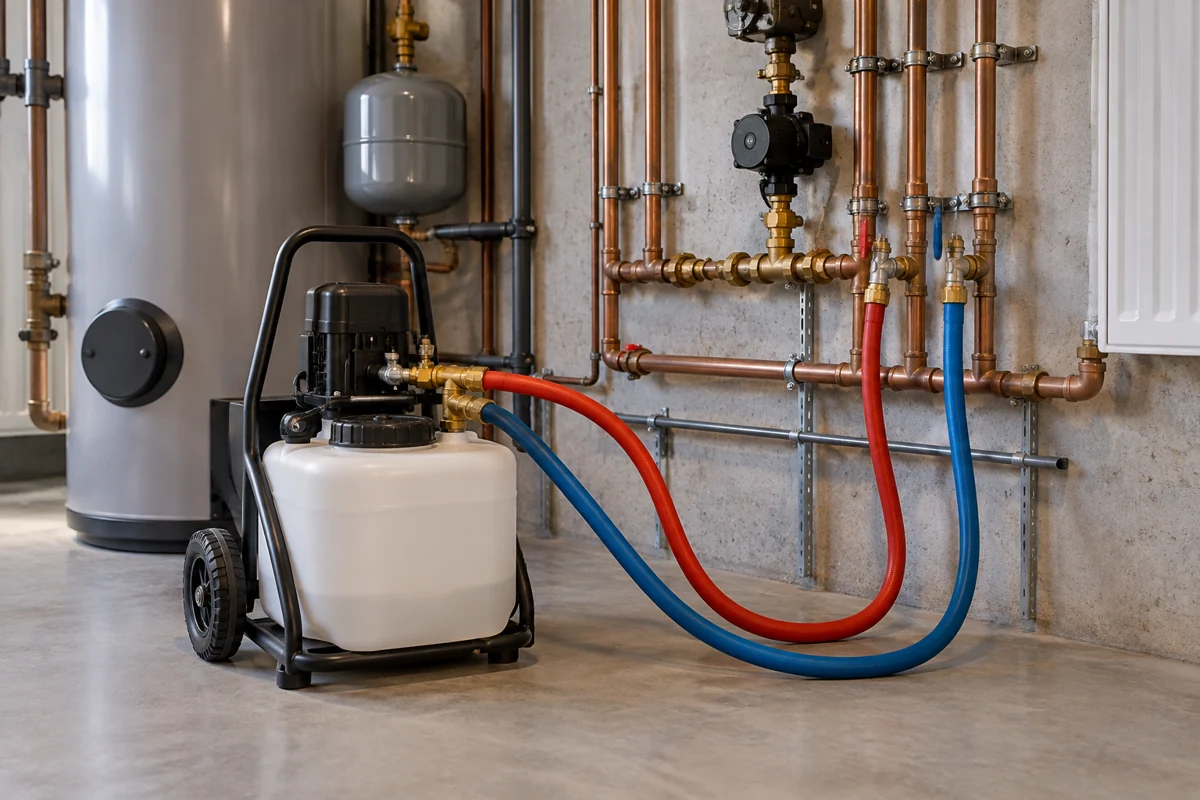
For suitable hydronic installations, a purpose-made flushing unit can circulate water through parts of the system to help remove deposits. The method needs an appropriate connection, controlled procedure, compatible products where used, and access to the circuits being treated. This is professional work involving hot water, chemicals, and connected equipment; it is not a homeowner hose-flushing exercise.
Cleaning cannot repair a fractured component, restore corroded metal, correct every installation problem, or replace a failed control. It should not be represented as a guaranteed route to a particular fuel saving. If an improvement is expected, ask the provider to identify the symptom or operating measure they intend to reassess and the limitations of the proposed work.
Ready to discuss your heating problem?
Share the symptoms and confirm the next step with an independent provider.
05 / SERVICE GUIDE
A useful maintenance plan has separate records
Appliance service record
Keep the date, provider, model identification, completed checks, parts replaced, and findings supplied by the professional. Record any recommended follow-up and any operating restriction. This is more useful than a generic sticker saying the boiler was serviced. If the equipment changes, retain the old history but begin a clear record for the replacement.
Water-side history
Note cleaning, refill, treatment, and filter-related work where applicable. Unexplained repeated additions of water deserve attention because they may indicate another problem. Do not add chemicals from a hardware-store recommendation without checking compatibility and dosage requirements through a suitable professional. Different products and systems may have different requirements.
Distribution and control changes
Document changes to radiator valves, circulation equipment, thermostats, and zones. A comfort problem that begins after an alteration may need a distribution or controls review rather than another cleaning visit. The history allows the provider to distinguish a new symptom from a long-standing issue that was never addressed.
06 / SERVICE GUIDE
Safe homeowner preparation
Keep access to the appliance and relevant emitters clear, retain the operating manual, and report leaks, unusual sounds, or recurring faults. Do not remove combustion covers, test safety valves, open hot drains, or pour treatment into an unfamiliar connection. Leave unidentified deteriorated insulation undisturbed and bring it to the provider’s attention before work begins.
If there is a gas odor, carbon monoxide alarm, fire, or another immediate danger, use the appropriate emergency response rather than waiting for a maintenance appointment. Ordinary servicing is planned work; it does not replace emergency assessment of an unsafe condition. The provider must determine whether the appliance can be operated during the visit.
07 / SERVICE GUIDE
Compare maintenance proposals clearly
Ask for separate descriptions of boiler servicing, diagnosis of a complaint, circuit cleaning, and replacement parts. Clarify whether a quoted flush includes all intended zones, what access is required, and what happens if a circuit cannot be treated. Confirm the expected interruption to heating or hot water and who can authorize additional findings.
An independent provider sets the price and recommendations. You should receive enough explanation to decide whether to proceed without relying on claims that every Medford home needs the same package. Where the diagnosis remains uncertain, ask whether further investigation would be more useful than committing immediately to an extensive cleaning process.
08 / SERVICE GUIDE
Maintenance and flushing questions
Does every boiler need an annual power flush?
No universal annual flushing schedule applies to every installation. Follow the appliance’s maintenance instructions and obtain a condition-based assessment of the water-side system. A routine service interval and a recommendation for circuit cleaning are separate decisions that should not be conflated.
Will flushing fix a cold radiator?
Only if an appropriate cleaning process addresses the actual cause. A valve, control, circulation, venting, or design issue may require another remedy. Review radiator and baseboard repair before assuming contamination is responsible.
Can a combi boiler’s hot-water issue need a different treatment?
Yes. Domestic hot water and space-heating water follow different pathways within the installation. The provider should identify the affected circuit before proposing a method. The gas and combi guide explains the diagnostic distinction.
What should I include in a request?
Use Request Service with the model, fuel, maintenance history, affected rooms, and any fault or leak. Say whether you want scheduled servicing or investigation of a specific complaint. Boiler Repair Pro connects you with independent providers; it does not own flushing equipment or perform maintenance.
Sources & further reading
Manufacturer references illustrate model-specific requirements. Use the manual for your own equipment; these references are not universal repair instructions.
Take the next step.
Tell us where help is needed and what your system is doing.